Two Jurisdictions, One Market: Belfast's Fintech Edge Is Hiding in Plain Sight

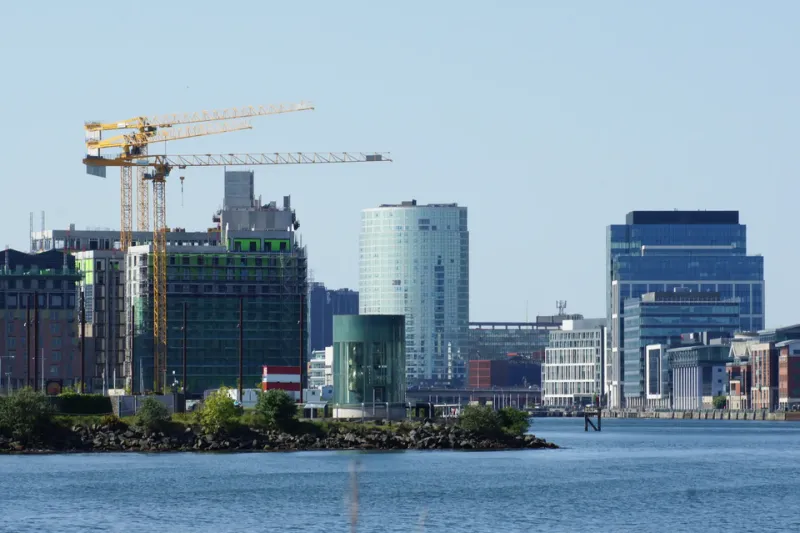
Photo: Thomas Nugent , CC BY-SA 2.0, via Wikimedia Commons
There is a familiar reflex in Northern Irish fintech commentary: compare Belfast to London, note the gap in capital, headcount and deal flow, and conclude that the city is a promising but peripheral cluster. It is a comfortable framing. It is also a strategic mistake.
Belfast is not a smaller London. It is the only significant fintech hub in the UK that sits on a land border with the EU's single market, with a legal and regulatory architecture — the Windsor Framework — designed to manage that duality. That is not a footnote to the city's fintech story. It is the story. And the founders and policymakers who treat it as an administrative inconvenience rather than a commercial advantage are leaving value on the table.
The Windsor Framework is a product specification
Most discussion of the Windsor Framework focuses on trade friction: customs procedures, green lanes, red lanes, the role of the EU Court of Justice. For fintech, the relevant question is different. The framework creates a set of operating conditions in which firms can serve both UK and EU customers from a Northern Ireland base, subject to the right authorisations and controls.
That is not a trivial advantage. A London-based payments firm serving EU customers must navigate a post-Brexit third-country relationship with the EU, often requiring a separate EU entity and authorisation. A Belfast firm with the right structure can, in principle, design products that operate across both markets with a single operational core — provided it takes dual compliance seriously from day one.
The problem is that too few founders do. Dual regulation is often treated as a cost to be minimised rather than a capability to be built. The result is firms that are either UK-first with a thin EU bolt-on, or EU-first with a London sales office. Neither captures the all-island opportunity.
Cross-border friction is the opportunity
Anyone who has moved money between a UK bank account and an Irish one knows that the experience is not seamless. SEPA transfers generally work, but they are not instant in the way that UK Faster Payments are. Currency conversion is opaque. Reconciliation for businesses operating on both sides of the border remains a manual, error-prone process. For small firms in sectors like agri-food, logistics and professional services, the border is a daily operational reality.
This is exactly the kind of friction that fintech exists to remove. Yet the market for cross-border payment and treasury tools tailored to the all-island economy remains under-served. The firms that solve it will not be London firms bolting on an Irish IBAN. They will be Belfast firms that understand both jurisdictions natively — the scheme rules, the bank holidays, the regulatory reporting expectations, the cultural quirks of doing business in Newry and Dundalk as well as Manchester and Glasgow.
Dual regulation: cost centre or competitive moat?
There is a reason founders avoid dual regulation: it is expensive and slow. Two regulators, two rulebooks, two sets of reporting requirements. The Central Bank of Ireland and the Financial Conduct Authority do not always speak the same language, and the compliance overhead for a small firm can be crushing.
But the firms that invest early in dual compliance build something valuable: the ability to sell into two markets without re-platforming. That is a moat. It is also a barrier to entry that protects Belfast-based firms from competitors who would need years to replicate their regulatory architecture.
The policy ask here is not deregulation. It is coherence. Regulators on both sides of the border should be encouraged to recognise each other's supervisory standards where outcomes are equivalent, and to provide clearer guidance for firms operating in the all-island market. The UK–Ireland fintech bridge already exists in principle. It needs to become operational for smaller firms, not just the large banks that can afford the legal bills.
Talent already ignores the border
One of the more persistent myths about Belfast's fintech labour market is that it is constrained by the border. In practice, talent is already all-island. Students from Dublin and across Ireland study at Queen's and Ulster. Engineers commute from border counties. The Common Travel Area means that Irish and British citizens can work in each other's jurisdictions without visa friction.
The constraint is not mobility. It is ambition. Belfast firms often recruit as if they are hiring for a local market, when they could be hiring for an all-island one. Dublin's financial-services ecosystem is deep, expensive and increasingly remote-friendly. A Belfast firm that positions itself as an all-island employer — with Dublin-facing roles, cross-border project teams and a genuine presence in both markets — can access a talent pool that London-centric competitors cannot.
Benchmark against Dublin and London — but not London alone
The right comparison for Belfast is not London in isolation. It is the combined UK–Ireland market. On that measure, Belfast is not peripheral. It is central. It sits between two capital cities, two regulators and two labour markets, with a land border that most fintech hubs would love to have.
That does not mean the city should be complacent. Capital is still scarce, the cluster is still thin, and the universities still need to produce more fintech-ready graduates. But the strategic framing matters. A city that benchmarks itself against London will always be a satellite. A city that benchmarks itself against the all-island market can be a hub.
The challenge to founders is to stop treating the border as a compliance headache and start treating it as a product differentiator. The challenge to policymakers is to make dual regulation workable for small firms, not just survivable for large ones. And the challenge to the wider UK fintech audience is to stop seeing Belfast as a regional outpost and start seeing it as the UK's gateway to the European single market — the only one it has left.