The Silage-Season Ledger: Belfast’s Agri-Food Chain as a Proving Ground for Embedded Finance
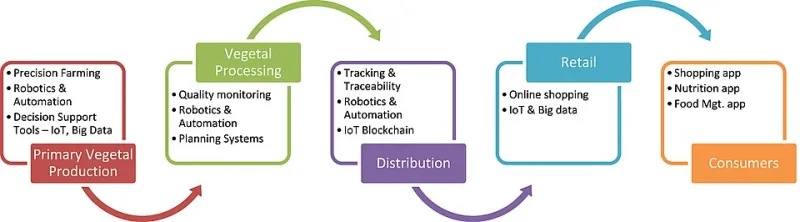
Photo: Authors of the study: Abdo Hassoun, Fatma Boukid, Antonella Pasqualone, Christopher J. Bryant, Guillermo García García, Carlos Parra-López, Sandeep Jagtap, Hana Trollman, Janna Cropotova, Francisco J. Barba, CC BY 4.0, via Wikimedia Commons
Northern Ireland’s agri-food sector is often described in terms of output: milk, beef, poultry, potatoes, mushrooms and the processors that turn them into products for UK retailers. Less discussed is the payment architecture underneath. It is a system of seasonal costs, monthly statements, quality adjustments and long retailer terms. For Belfast’s fintech community, that awkward calendar is not a niche inconvenience. It is a useful testing ground for embedded finance.
The appeal is straightforward. Agri-food supply chains generate frequent, verifiable events: a load leaves a farm, a weighbridge records a weight, a processor grades a batch, a retailer confirms a delivery. Each event is a potential trigger for a payment, a credit decision or a forecast update. Yet the financial layer often lags behind the physical one. Closing that gap could improve working capital for suppliers and give lenders better data. It could also produce lessons for UK SMEs in any sector where cash arrives well after the work is done.
A cash-flow calendar, not a balance sheet
Farming is not a uniform business. Dairy producers face monthly milk cheques but daily costs. Beef and sheep farms sell in cycles. Horticulture and potato growers carry input costs long before harvest. Processors, meanwhile, manage their own exposure to retailer promotions, specification changes and wastage. The result is a chain of overlapping cash-flow gaps rather than a single credit problem.
Traditional lending struggles with this because it looks at annual accounts and a snapshot balance sheet. Embedded finance can look at the operating rhythm. If a fintech can see confirmed deliveries, agreed prices and historical acceptance rates, it can model when cash is likely to arrive and where the pinch points sit. That is more useful than a generic overdraft for a business whose income is lumpy but predictable in shape.
The first practical product is not a loan. It is a forecast. A cash-flow tool that pulls delivery data from a processor, combines it with input costs and flags a shortfall four weeks ahead would give a farm or small supplier time to act. Belfast has a cluster of data and payments firms that could build such a tool around existing accounting software rather than asking farmers to adopt another platform.
Where the payment actually breaks
The weakest link in the chain is rarely the bank transfer itself. It is the evidence that justifies the transfer. A load may be accepted at the processor gate but adjusted later for grade, temperature or packaging. An invoice may be raised before the final price is agreed. A retailer may apply a deduction that takes weeks to explain. In these conditions, invoice finance becomes less about lending against a PDF and more about lending against an agreed event.
That distinction matters. A Belfast fintech working with a processor could build a payment product that is triggered when a delivery is verified and matched to a contract. The supplier could choose immediate payment at a small discount, or wait for the standard term. The processor could reduce manual reconciliation. The lender could rely on the processor’s confirmation rather than the supplier’s paperwork.
This is not a fantasy of fully automated agriculture. Many farms still run on paper, phone calls and trusted relationships. The point is to meet the chain where it is. A simple supplier portal that confirms delivery and shows a payment date may deliver more value than a sophisticated credit engine. The fintech opportunity is in the middle ground: digitising the handoff without demanding that every participant become a software company.
The processor as anchor
Embedded finance works best when there is an anchor. In agri-food, the processor is often that anchor. It sits between thousands of suppliers and a smaller number of retailers. It already holds delivery records, quality data and payment histories. It has an incentive to keep suppliers viable, especially where a single farm supplies a specialist line.
A Belfast-based pilot could start with one processor and one category, such as dairy or poultry, where volumes are regular and data is relatively standardised. The fintech would not need to onboard every farm at once. It could begin with suppliers who already use accounting software and want earlier payment. The processor would provide the event data. A bank or funding partner would provide the capital. The measure of success would be simple: fewer days between delivery and payment, fewer queries, and a forecast that farmers trust.
There are risks. Commercial finance must be priced for thin margins. Farmers are wary of products that look like debt. Processors may not want to expose their payment terms to a third party. Retailer deductions can complicate the cleanest data set. These are reasons to pilot carefully, not reasons to ignore the sector.
Lessons beyond the farm gate
The broader lesson for UK SMEs is that embedded finance is most credible when it attaches to a specific operational event. A construction subcontractor waiting for a certified valuation, a logistics firm waiting for a proof of delivery, or a professional services firm waiting for a signed milestone all face a version of the same problem. The agri-food chain simply makes the problem visible because the seasons are so pronounced.
As 2026 enters its final weeks, Belfast has an opportunity to treat agri-food as a laboratory rather than a legacy sector. The ingredients are present: a dense supplier base, anchor processors, a border economy that demands robust documentation, and a fintech cluster looking for practical use cases. A successful pilot would not transform agriculture overnight. It would show that payments can follow the physical flow of goods, not the other way around. That is a modest ambition, but a useful one for a city that wants to build financial products with operational roots.