The Tip Trail: Belfast’s Hospitality Back Office Is Ripe for a Pilot
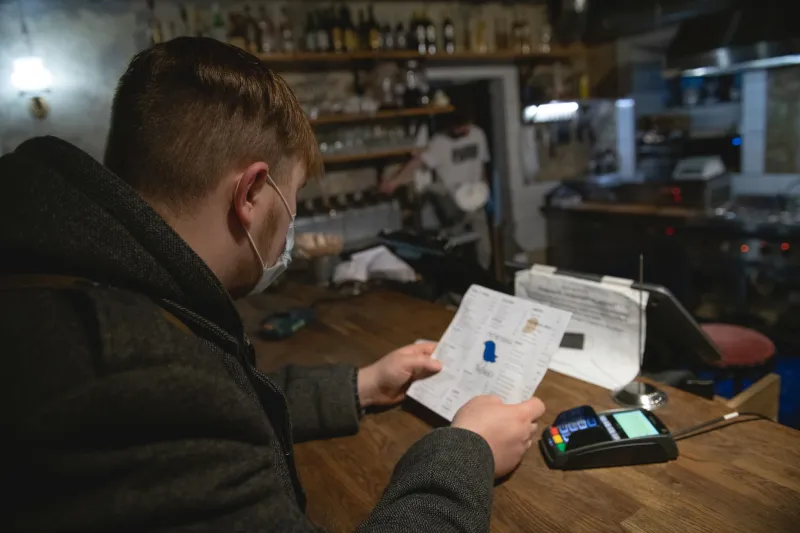
Belfast hospitality has become adept at taking money. A card tap, a QR code, a booking deposit and a round of drinks can all be processed in seconds. The difficulty begins after the customer leaves: the card tip that must be allocated, the service charge that must be recorded, the tronc arrangement that must be explained, and the payroll run that must reconcile all of it. For many independent bars, restaurants and hotels, that trail still ends in a spreadsheet.
This is not a glamorous corner of fintech. It is, however, a practical one. Tips, service charges and gratuities sit at the intersection of payments, payroll and employment compliance. They involve small sums, high volumes and real people who notice when the numbers do not add up. That combination makes hospitality a useful testbed for Belfast — not because the city lacks payment terminals, but because the back office behind those terminals remains stubbornly manual.
A payment is not a pay record
Card acquirers and electronic point-of-sale systems are good at capturing transactions. Payroll bureaux and software are good at calculating pay. The gap between them is where tips and service charges become a manual exercise. A venue may run one report from the card machine, another from the EPOS, a third from the rota and a fourth from the payroll provider. Someone then matches staff hours to allocations, applies the house rules, checks the tronc calculation and produces a payslip line.
In a small independent venue, that someone is often the owner or a duty manager. In a hotel or multi-site group, it may be a central finance team dealing with different till systems and local practices. Either way, the process is fragile. A late shift change, an agency worker, a card tip refunded after a complaint or a service charge split between front-of-house and kitchen can turn a routine run into an investigation.
The customer sees a simple prompt on a card reader. The worker sees a figure on a payslip. The operator sees a compliance obligation. A better system would let all three see the same trail.
The compliance bar has moved — unevenly
In Great Britain, the Employment (Allocation of Tips) Act 2023 and its accompanying code of practice, in force since October 2024, set a statutory baseline for how qualifying tips, gratuities and service charges are allocated. Employers are expected to have a written policy, allocate fairly, keep records and be able to explain the basis for distribution.
Northern Ireland’s employment law is devolved, so the same statutory framework does not simply apply here. That divergence is not a shelter. Multi-site operators with venues in Great Britain already need GB-compliant records. Staff who move between jurisdictions, investors conducting due diligence and customers reading about tipping practices all push in the same direction: a clear, documented allocation process. For Belfast operators, the commercial question is not whether they will be asked to show their workings, but how quickly they can produce them.
This is where payments infrastructure meets payroll infrastructure. A card terminal can capture a tip, but it cannot decide whether it belongs to an individual, a pool or a tronc. A payroll system can process an allocation, but it cannot reconstruct the original transaction if the audit trail lives in a spreadsheet. The missing layer is an allocation ledger that sits between the two.
What a Belfast pilot should test
A useful pilot would not begin with a new consumer app. It would begin with the data model. The aim should be to take transaction-level tip data from the payment terminal, apply a venue’s written allocation rules, and export a payroll-ready record that can be audited. A small cohort of Belfast venues — from Cathedral Quarter bars to hotel restaurants and suburban cafés — could test three things:
- Capture: whether card tips and service charges can be tagged at the point of payment without slowing service or confusing staff.
- Allocation: whether house rules for splitting, pooling and tronc can be encoded clearly enough to produce consistent outcomes across shifts.
- Export: whether the resulting record can be accepted by payroll software and understood by workers without a separate explanation.
The pilot should be deliberately modest. Hospitality operates on thin margins and unpredictable hours. A system that adds a new dashboard but leaves the payroll run untouched will be abandoned. A system that removes a reconciliation step, or gives a manager a defensible record when a worker queries a split, has a chance.
Worker visibility is not a nice-to-have
Much of the public debate about tipping focuses on fairness between front-of-house and kitchen staff. That matters. But there is a quieter issue: visibility. A worker who receives a monthly payslip with a single figure for tips has little way of knowing how that figure was built. Did the Saturday night card tips go into the pool? Was the service charge treated the same way as a cash gratuity? What happened to the tip left on a bill that was later discounted?
Near-real-time allocation records would not answer every question, but they would make the conversation more concrete. A worker could see the transactions attributed to their shift, the allocation rule applied and the amount due before payroll. An operator could point to the same record. That is not just a compliance feature; it is a trust feature in a sector that relies on transient and part-time staff.
There is a talent angle here too. Hospitality in Belfast competes for staff with retail, logistics and customer service. Clearer pay records are part of the offer. A venue that can show a prospective employee exactly how tips are handled has an advantage over one that says it will be sorted out at the end of the month.
The export case
Northern Ireland is small enough to pilot and close enough to Great Britain to scale. A tipping and payroll reconciliation product built for Belfast venues could be sold to independent operators across the UK, to hotel groups with multi-site payroll and to payroll bureaux serving hospitality. It could also support the growing compliance market around employment records, wage statements and audit trails.
The broader opportunity is not a single app. It is a connector. Belfast already has payment firms, payroll providers and a dense hospitality sector within a compact geography. A pilot that links them would produce something more useful than another dashboard: a repeatable model for turning payment data into payroll evidence. If it works here, it can travel.
The back office as a front door
Belfast’s fintech story often centres on bigger themes — open banking, regulation, talent and cross-border trade. Hospitality tipping may look small by comparison. But small, frequent, people-intensive processes are where financial technology proves itself. The sector does not need a revolution in how customers pay. It needs a better trail from the card reader to the payslip.
A controlled pilot would not solve every problem in Belfast hospitality. It would, however, test whether the city can build a product that makes an awkward back-office task auditable, understandable and exportable. That is a modest ambition with a practical edge — and it starts with the tip that never quite makes it cleanly from the terminal to the payroll run.